People tend to assume a real course has 18 holes. Guests rarely count. What they notice is whether the round felt worth the money and whether they spent half of it waiting behind another group.
01Start from the visit you want to sell
Decide how long a round should take. Then think about what guests do next. If you have a bar, a shorter round can be good business, because people finish with energy and money left for a drink. If the course is the whole visit, guests need enough play to feel the ticket was fair.
Hole count follows from that decision. Nine strong holes can suit a bar or a small unit. Eighteen is a solid full evening. More than that, split into separate courses, lets a large venue handle more groups at once.
02Let the floor set the limit
Squeezing in extra holes usually backfires. Tight paths, no room to swing and groups bumping into each other make the room feel cheap. Think about how many groups will be on the course at the same time, and leave space to overtake, to wait comfortably and to take photos.
- Measure real usable floor. Columns, fire routes and service access take more than you expect.
- Count the bar and seating. That space earns money too, so don't give it all to holes.
- Plan the flow. A loop that starts and ends near the bar works better than a dead end.
03Quality beats quantity
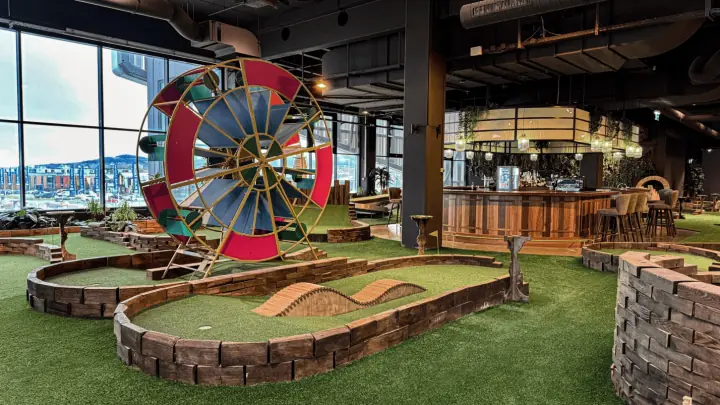
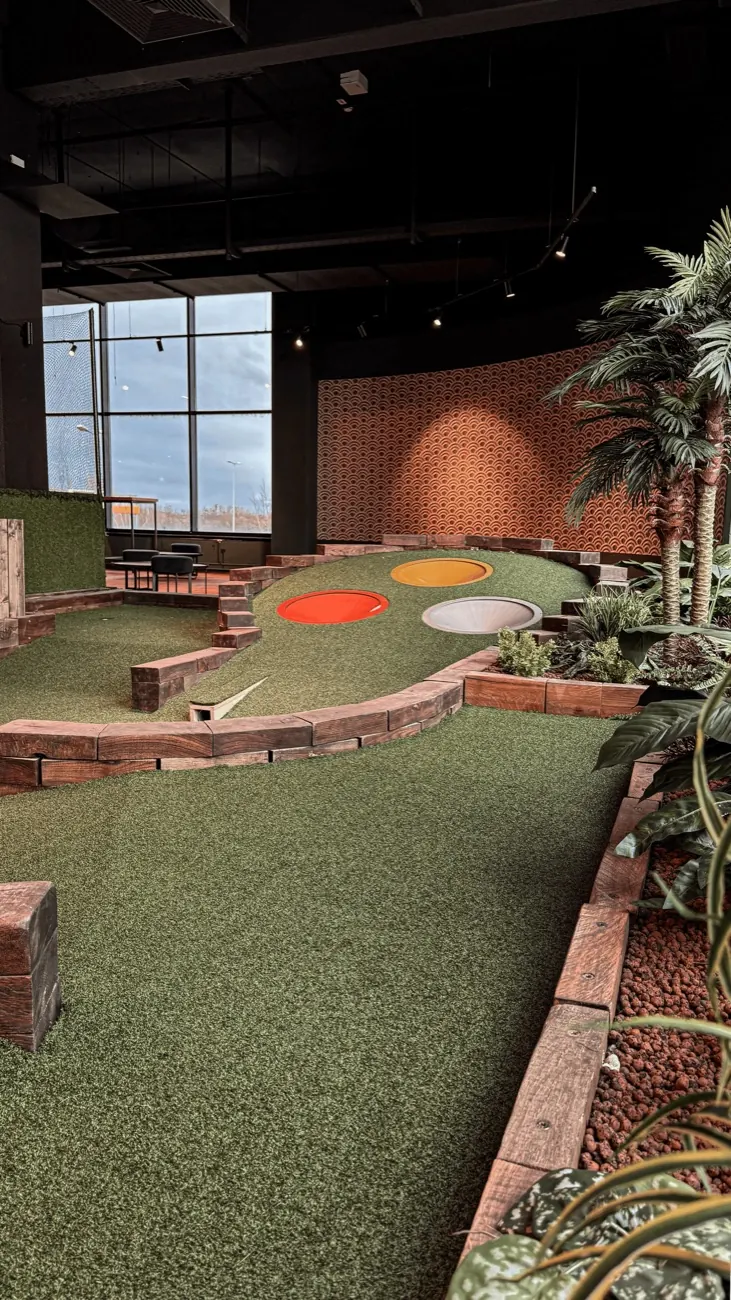
One remarkable hole does more for your reputation than three plain ones. Each hole should be easy to understand and different from the last, and a few should be memorable. Budget accordingly. It's better to build fewer holes well than to spread the money thin.
More than one course
Splitting holes into themed courses helps a bigger venue. At DSTRCT, 27 holes are organised as three courses, so guests get variety and the venue gets more ways to sell a visit.
04Test it before you build
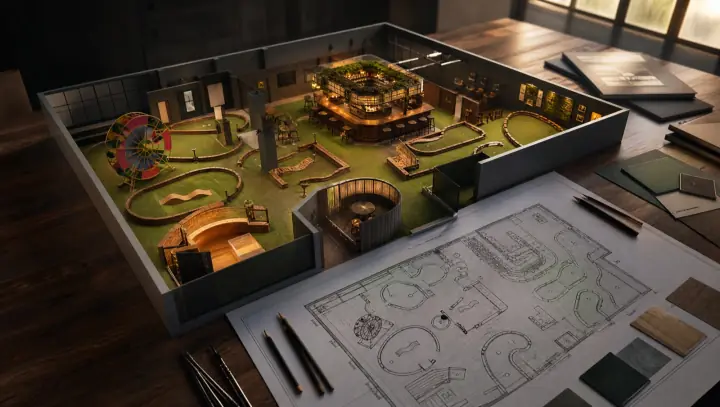
Draw the layout, walk it at full size and time a pretend round with a few people. Problems that are free to fix on paper are expensive in timber and steel.
We do this hole by hole in 2D and 3D before anything gets cut.